Questions, Answers, & Explanations
Get clear explanations behind every answer, perfect for deeper learning and more thorough exam preparation.

A Journeyman Steamfitter Study Guide and a Journeyman Pipefitter Study Guide are designed to support individuals preparing for work in industrial and commercial piping environments. Steamfitters and pipefitters specialize in installing, maintaining, and repairing high-pressure piping systems that carry steam, liquids, and gases for industrial processes. For those exploring related mechanical systems, you can also review this area.
These trades are commonly employed in power plants, manufacturing facilities, refineries, chemical plants, and large commercial or institutional buildings. Unlike residential plumbing, steamfitting and pipefitting focus on complex piping systems that operate under high pressure and temperature, requiring precise installation, advanced safety awareness, and strict adherence to technical specifications.
This study guide is intended as a supportive learning resource and does not replace formal apprenticeships, licensing requirements, or employer-specific training.

Most steamfitters and pipefitters enter the trade through a registered apprenticeship program that combines classroom instruction with extensive on-the-job training. Apprenticeships typically last four to five years and are offered through unions, contractors, and industry training organizations.
During training, apprentices learn piping fundamentals, blueprint reading, isometric drawings, welding and joining methods, pipe layout, and system testing procedures. Classroom instruction is paired with field experience under the supervision of experienced journeypersons.
Training also emphasizes workplace safety, particularly when working with pressurized systems, hazardous materials, and heavy industrial equipment. Many apprenticeship programs follow standards overseen by the U.S. Department of Labor to ensure consistent skill development across the trade.
This Journeyman Steamfitter / Pipefitter Study Guide reinforces the technical knowledge commonly required during training and assessments. If you're looking to understand how fluid systems apply across industries, take a look at this section.
Steamfitters and pipefitters perform closely related work and are often grouped together under a single trade classification. Both work with industrial piping systems, but their focus areas may vary depending on the project.
Steamfitters typically work on systems involving steam, high-temperature fluids, and pressure-controlled environments such as power generation facilities. Pipefitters may work across a wider range of piping systems, including chemical processing lines, hydraulic systems, and industrial fluid transport.
In practice, many journeypersons are trained to perform both roles, especially on large industrial projects. Employers often expect versatility, strong technical understanding, and the ability to work from detailed drawings and specifications.
Assessments for steamfitters and pipefitters usually include written and practical components. Written exams evaluate knowledge of piping systems, materials, safety practices, and technical calculations.
Common exam topics include pipe fabrication, layout techniques, welding fundamentals, system testing, and interpreting isometric drawings. Candidates are also assessed on their understanding of workplace safety regulations and hazard control.
Practical assessments often involve hands-on tasks such as cutting and fitting pipe, assembling spools, performing alignment checks, and demonstrating safe work practices. These evaluations measure precision, technical competence, and adherence to procedures.
Preparation using a Steamfitter/Pipefitter Online Test or Steamfitter/Pipefitter Online Mock Test can help candidates become familiar with exam formats and expectations.
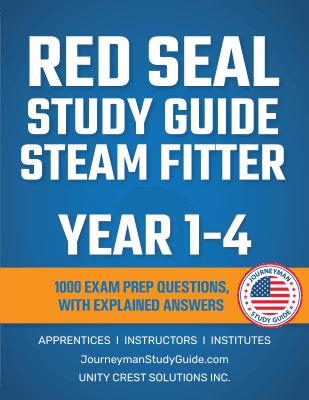
This Journeyman Steamfitter / Pipefitter Study Guide is structured to support learners preparing for assessments, job evaluations, or skill refreshers. It focuses on reinforcing trade fundamentals rather than making claims about exam outcomes.
The guide covers industrial piping concepts, system components, safety awareness, and common job-site scenarios. It also supports Journeyman Steamfitter/Pipefitter Exam Prep by reviewing topics commonly evaluated during written and practical assessments.
By working through the material, learners can strengthen technical understanding, improve accuracy, and approach assessments with greater confidence.
Steamfitters and pipefitters work in a wide range of industrial and commercial environments. Common employers include power generation companies, manufacturing plants, refineries, chemical facilities, and large construction contractors.
With experience, journeypersons may advance into roles such as lead hand, foreman, piping supervisor, or project coordinator. Some transition into inspection, quality control, or training positions, depending on additional qualifications.
Due to the technical nature of the trade, experienced steamfitters and pipefitters are often in demand for shutdowns, major installations, and specialized industrial projects. You can also explore similar high-demand technical pathways through this field.
Several recognized organizations support education, training, and safety standards within the steamfitting and pipefitting trades. Training frameworks and credentials are often aligned with programs developed by the National Center for Construction Education and Research.
Workplace safety standards are established and enforced by the Occupational Safety and Health Administration, particularly in industrial environments involving pressurized systems and hazardous materials.
Professional trade organizations and joint apprenticeship committees also play a key role in skills development and workforce standards.
A new entrant to the steamfitter/pipefitter trade may be a recent migrant or someone transitioning from a related mechanical trade. This individual may have basic fabrication or welding skills but limited exposure to U.S. industrial piping standards.
Early challenges often include learning local safety regulations, understanding detailed isometric drawings, and adapting to job-site workflows. Industrial terminology and documentation practices may also take time to master.
With structured apprenticeship training and hands-on experience, entry-level candidates can gradually develop the skills needed to work independently on industrial piping systems.
An experienced steamfitter or pipefitter brings extensive practical knowledge and problem-solving ability developed over many years. However, relocating or changing employers may require learning different codes, procedures, or site-specific standards.
Formal assessments or journeyman verification may still be required, even for experienced professionals. Once these requirements are met, experienced workers often move into leadership roles, supervising crews, mentoring apprentices, or managing complex piping installations.
Their experience is particularly valuable on high-risk or technically demanding projects.
Most individuals complete four to five years of apprenticeship training before reaching journeyman status.
No. Steamfitting and pipefitting focus on industrial and high-pressure systems, while plumbing typically involves residential and commercial water and drainage systems.
Licensing requirements vary by state and employer, but completion of an accredited apprenticeship is commonly required.
Common industries include power generation, manufacturing, refineries, chemical processing, and large-scale construction.
No. This study guide is a supportive learning resource and does not replace formal training, apprenticeships, or employer requirements.
Get clear explanations behind every answer, perfect for deeper learning and more thorough exam preparation.
Quick and easy practice to test your knowledge anytime, anywhere—ideal for simple, on-the-go preparation.